Semi trucks depend on powerful electrical systems to start large diesel engines and operate onboard electronics. A common question among drivers and technicians is “Are Semi Truck Batteries 12V or 24V?”
Understanding the wiring configuration is critical when diagnosing electrical failures, replacing batteries, or performing semi truck battery repair. Incorrect assumptions about system voltage can damage starters, alternators, and electrical components. This guide explains how semi truck battery systems work, how batteries are wired, and why professional technicians often rely on mobile truck repair service and specialized battery repair service when electrical failures happen on the road.
Highlights
- Most modern semi trucks in North America use 12V batteries and a 12V electrical system.
- Many trucks use multiple 12V batteries wired in parallel to provide the high cold cranking amps (CCA) needed to start large diesel engines.
- European and other international heavy-duty trucks often use 24V electrical systems.
- 24V systems are typically created by wiring two 12V batteries in series, which doubles the voltage.
Why Semi Trucks Use More Than One Battery
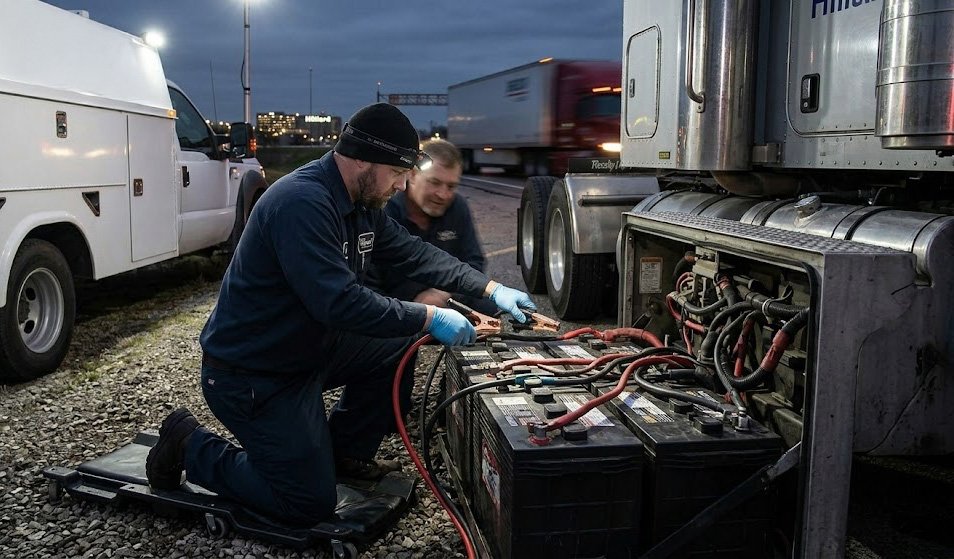
A semi truck needs much more starting power than a passenger vehicle. Diesel engines require high cranking amperage, especially in cold weather. That is why many trucks use multiple batteries. In a common North American setup, the truck may still be a 12V system, but it uses two or more 12V batteries in parallel so the system can deliver more current without changing the voltage. Dual, triple, and even four-battery arrangements are common depending on the truck and its electrical load.
This is where confusion starts. A truck owner may see two batteries and assume the truck is 24V. That is not always correct. Two 12V batteries can still produce 12V total if wired in parallel. The layout matters more than the battery count.
12V vs 24V: What the Difference Really Means
The difference between 12V and 24V is in how electrical power is delivered through the truck. A 12V system is familiar, widely supported, and common in North American service environments. A 24V system delivers the same power with lower current, which can reduce wiring size, heat, and electrical strain in some applications. 24V systems are often preferred for heavy-duty equipment because they support bigger loads with less amperage.
That is one reason 24V remains common in many heavy-duty trucks outside the US. It is also why manufacturers are exploring or releasing newer 24V architectures in North America. Volvo Trucks, for example, announced a new 24-volt electrical architecture in its next-generation North American truck platform.
How 12V Semi Truck Battery Wiring Works
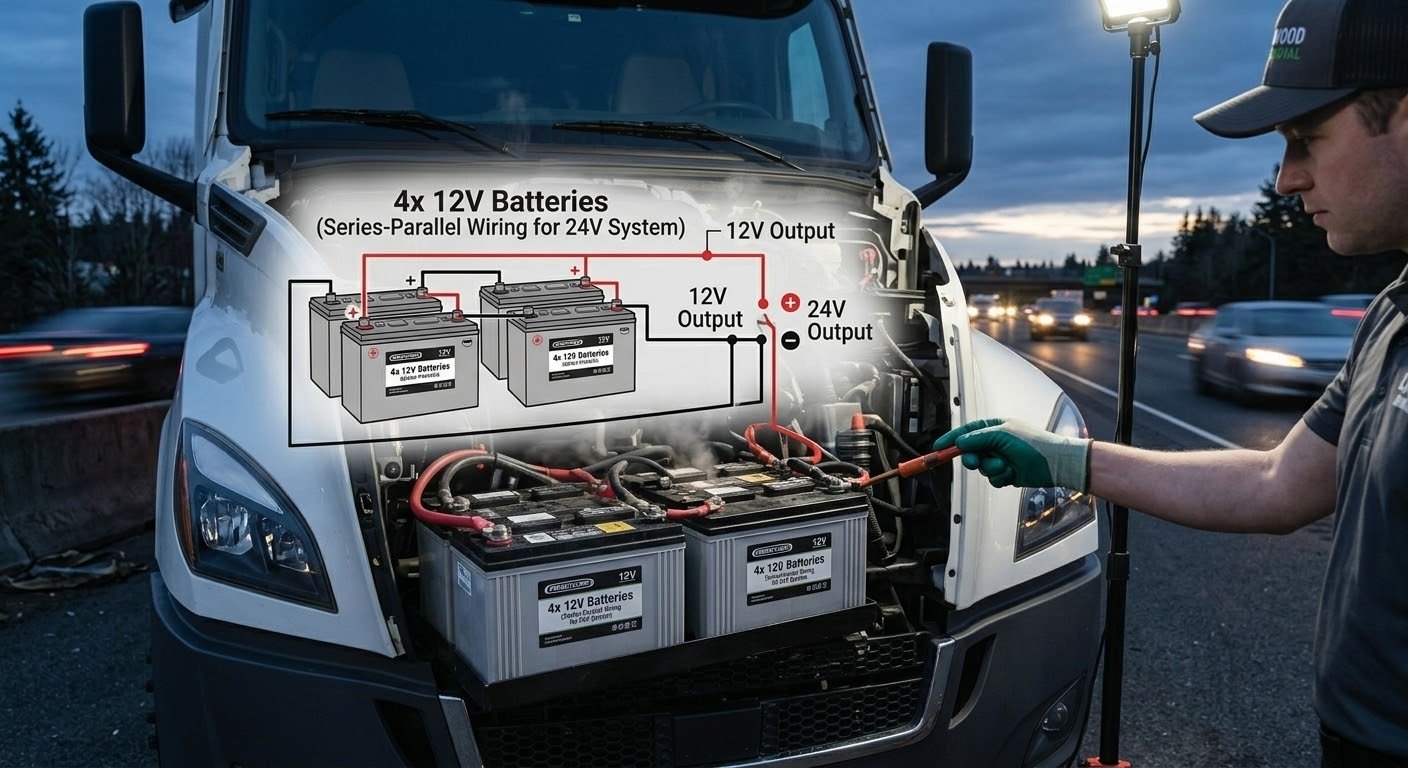
In a standard 12V semi truck battery repair situation, the most common battery bank uses parallel wiring. In parallel, the positive terminal of one battery connects to the positive of the other, and the negative connects to the negative. This keeps the voltage at 12V, but increases the available amp capacity and cranking output. Parallel wiring increases overall capacity while keeping voltage the same.
That setup is common because a diesel engine needs strong starting power, but many North American trucks still run 12V accessories, controls, and charging systems. So the truck gets more starting strength without moving the whole truck to 24V.
How 24V Semi Truck Battery Wiring Works
A true 24V setup usually uses series wiring. In series, the negative of one battery connects to the positive of the next battery. That doubles the voltage. Two 12V batteries in series produce 24V total. Series connections increase voltage while amp-hour capacity stays the same.
This kind of setup is common on many international heavy-duty trucks and on equipment that needs higher voltage for starting and major electrical loads. Some heavy-duty systems may also use a 12/24 split, where 24V supports starting while parts of the vehicle still run on 12V. That is why checking the actual truck wiring diagram or OEM specs matters before replacing batteries, chargers, starters, or alternators. SAE standards for heavy-duty truck and bus electrical performance also specifically address starter motors in nominal 12V and 24V systems, which reflects how common both formats are in commercial applications.
How to Tell if a Semi Truck Is 12V or 24V
The safest way is to get it checked by a professional. A roadside technician or fleet mechanic should check:
1. The battery label
Each battery may say 12V, but that alone does not confirm the truck’s total system voltage.
2. The wiring layout
Parallel usually means the truck remains 12V. A series usually means the truck is running 24V.
3. The OEM manual or wiring diagram
Manufacturers do not all use the same setup. Even within one market, configurations can vary by model and application.
4. A multimeter test
Voltage should be checked across the proper main terminals before charging, boosting, or replacing components. This helps prevent damage during service.
Why This Matters for Roadside Repairs
Voltage mistakes are expensive. Using the wrong charger, jump pack, alternator, or replacement battery can create immediate electrical problems. A truck that will not start may have a battery issue, a starter issue, a charging fault, cable corrosion, or a wiring problem. Proper diagnosis starts with confirming the voltage and battery bank layout first.
That is where Truck N Trailer Roadside can help. When a driver is stuck with dead batteries, weak cranking, cable failure, or charging issues, fast on-site help is often the best option. A professional mobile truck repair service can inspect the electrical system on location. A dedicated mobile electric system repair service can help identify whether the problem is the battery bank, alternator, starter circuit, or wiring fault. Call us at 614-423-6164 to discuss your needs.
Final Answer
So, are semi truck batteries 12V or 24V? In modern trucks, the answer is both, depending on the truck. For any no-start issue, charging fault, or wiring concern, correct voltage identification comes first. That is the foundation of safe semi truck battery repair and reliable roadside service.
FAQs
Why does a semi truck have two or more batteries?
A semi truck needs high cranking power for a large diesel engine. Multiple batteries help provide more current and reserve capacity, especially during cold starts and heavy electrical demand.
Do two 12V batteries always mean the truck is 24V?
No. If the batteries are wired in parallel, the system stays at 12V. If they are wired in series, the system becomes 24V. The wiring layout decides the final voltage.
How can roadside techs tell if a truck is 12V or 24V?
They should check the wiring diagram, inspect battery connections, verify system voltage with a multimeter, and review OEM specifications before charging or replacing parts.
When should a truck call for semi truck battery repair?
A truck should be checked when it has slow cranking, repeated jump-start needs, dim electrical power, charging warnings, battery corrosion, or a no-start condition. Those symptoms can point to battery, cable, starter, or alternator issues.
Does 24V mean better than 12V?
Not always. A 24V system can be more efficient for heavy electrical loads because it uses less current for the same power. But 12V systems remain common, serviceable, and effective in many North American semi trucks.